How to Build a Referral Machine by Nurturing New Real Estate Agents
The 50-Week Game: How to Build a Referral Machine by Nurturing New Real Estate Agents (Not Fighting Over the Old Ones)
Let me tell you a secret that most home inspectors will never figure out:
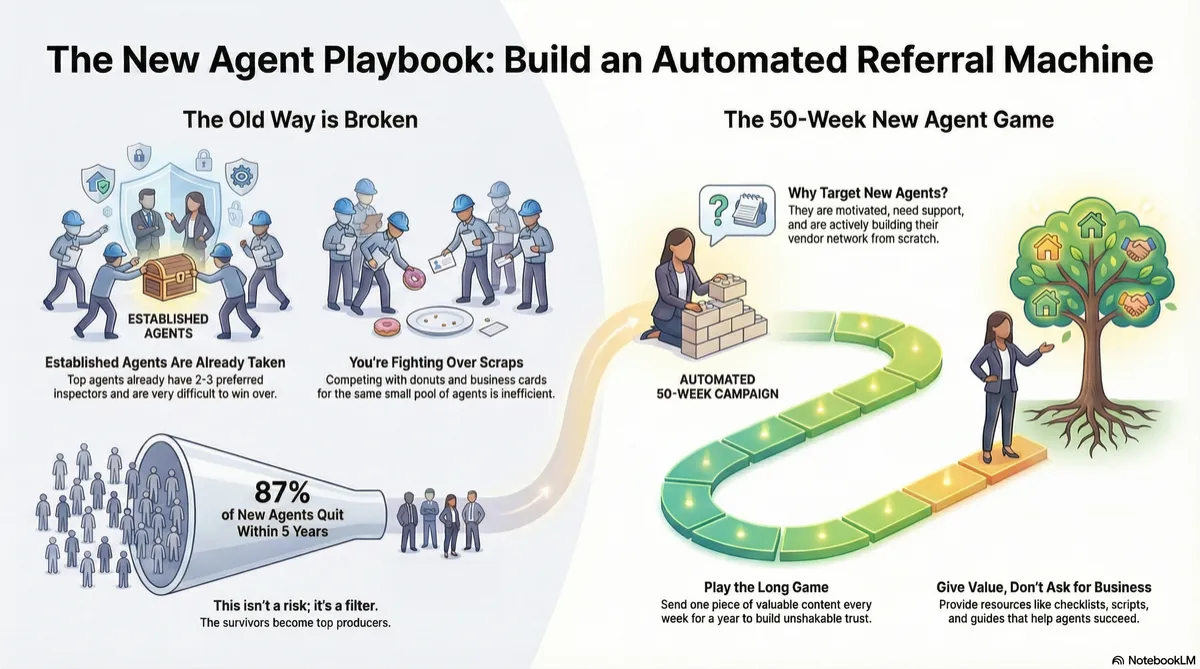
While everyone else is bringing donuts to the same real estate office for the 47th time this year, hoping to stay on someone's "preferred vendor list," there's a completely different game happening right under your nose.
And it's a game where you're not competing with anybody.
The game is called: Get to the new agents first.
See, here's what most inspectors don't realize:There are approximately 1.49 million real estate agents in the United States. And despite the headlines about the industry shrinking, thousands of new agents get their licenses every single month.
These new agents are hungry, motivated, and—here's the key—they don't have a "go-to" inspector yet.
While your competitors are wasting time trying to steal referrals from established agents (who already have their favorite inspectors on speed dial), you could be building relationships with agents who are just starting out and looking for someone they can trust.
Someone like you.
And the best part? You can do all of this automatically, using the tools you already have inside our GetSync agency which runs GoHighLevel (GHL).
Let me show you exactly how this works.
Why New Agents Are the Biggest Opportunity Nobody's Talking About
First, let's talk about why new agents are such a golden opportunity—and why most inspectors are missing it completely.
The Failure Rate Is Brutal (Which Means the Survivors Are Goldmines)
Here's a stat that'll blow your mind: 75% of new real estate agents quit within their first year. And 87% don't make it past five years.
Now, before you think, "Why would I waste time on people who are just going to quit?"—hear me out.
The ones who don't quit? Those are the agents who are going to dominate the next decade.
Think about it: If you build a relationship with 100 new agents, and 75 of them wash out... you're still left with 25 agents who survived the hardest year of their careers. And guess who they're going to remember when they finally start closing deals?
The inspector who was there from day one. The one who believed in them. The one who sent them helpful resources every single week—not just when they had business to give.
That inspector is you.
New Agents Are Desperate for Support (And Nobody's Giving It to Them)
Let's talk about what new agents are actually going through in that brutal first year.
They're:
Terrified they made a mistake leaving their old job
Overwhelmed by everything they don't know (contracts, inspections, appraisals, title, escrow... the list is endless)
Broke (the median first-year agent earns between $30,000-$40,000, and half of all agents sold zero or one home last year)
Desperate for mentorship (but most brokerages throw them a desk and say "good luck")
Building their referral network from scratch (and they have no idea who to trust)
In short: New agents need help. Badly.
And here's the crazy part: Almost nobody is helping them.
Sure, their brokerage might offer some training. But when it comes to building their vendor network—finding reliable inspectors, contractors, lenders, title companies—they're on their own.
That's your opening.
Established Agents Are Already Taken (And They're Harder to Impress)
Let's be real for a second.
That agent who's been in the business for 10 years and closes 30 deals a year? She already has three home inspectors she trusts. She's not looking for a fourth.
And even if you somehow get on her radar, you're competing with inspectors who've been feeding her referrals for years. You're going to have to work really hard to displace them.
But a brand-new agent who just got their license last month? They don't have anybody.
They're actively building their network right now. And if you position yourself as a helpful resource—not just another vendor trying to get their business—you can become their "go-to" inspector before they even close their first deal.
Think about that. While your competitors are fighting over scraps from agents who've already made their vendor choices, you're building relationships with agents who haven't chosen anybody yet.
You're not competing. You're planting seeds.
The 50-Week Nurture Campaign: Playing the Long Game (Because Nobody Else Will)
Alright, so you understand why new agents are the opportunity. Now let's talk about how to actually capture that opportunity.
This is where most inspectors completely drop the ball.
They meet a new agent at a networking event, exchange business cards, maybe send one follow-up email... and then nothing. The agent never hears from them again until they randomly reach out six months later asking for referrals.
That's not relationship building. That's spam.
Here's what actually works: A long-term, value-driven nurture campaign that keeps you top-of-mind for an entire year.
And I'm not talking about sending generic "check-in" emails every month. I'm talking about a 50-week automated email drip campaign with 50 unique lead magnets—one piece of valuable content delivered every single week.
Let me break down exactly why this works.
Why 50 Weeks? Because Trust Takes Time
Think about how long it takes for a new agent to:
Get their license (done)
Join a brokerage
Start prospecting for clients
Get their first buyer under contract
Schedule a home inspection
Actually close the deal
That's months. Sometimes six months. Sometimes longer.
If you only stay in touch for 8-12 weeks (like most drip campaigns), you're giving up right before the payoff.
But if you nurture that relationship for an entire year—delivering value every single week—you're there when they're finally ready to refer business.
And here's the kicker: Almost nobody else has that kind of patience. Which means by week 30, you're the only inspector still showing up in their inbox with helpful content.
Guess who they're going to call?
Why 50 Lead Magnets? Because Agents Need More Than Your Business Card
Here's what doesn't work: Sending the same generic email 50 times.
"Hey [Agent Name], just checking in! Let me know if you need a home inspector!"
Delete. Delete. Delete.
Here's what does work: Sending 50 different pieces of valuable content that help them succeed in their first year.
Lead magnets for new agents could include:
Week 1:"The Ultimate Home Inspection Checklist for Agents (What to Tell Your Clients)"
Week 2:"10 Red Flags Every Agent Should Know Before Listing a Home"
Week 3:"How to Explain Inspection Results to Nervous First-Time Buyers"
Week 5:"The Agent's Guide to Pre-Listing Inspections (Why Smart Sellers Do Them)"
Week 8:"What to Do When the Inspection Reveals Major Issues (Script Included)"
Week 12:"How to Build Your Dream Vendor Team in 90 Days"
Week 15:"Understanding Inspection Contingencies: A Simple Guide for New Agents"
Week 20:"How to Handle Deal-Killing Inspection Reports (Without Losing the Sale)"
Week 25:"The Top 5 Inspection Mistakes That Cost Agents Referrals"
Week 30:"Why Thorough Inspections Protect You AND Your Clients"
Week 40:"How to Position Yourself as the 'Go-To' Agent in Your Market"
Week 50:"Year-End Review: How Many Transactions Did You Close? (And How to Double It Next Year)"
Notice what's happening here?
You're not asking for anything. You're giving, giving, giving.
You're teaching them. You're making them better at their job. You're becoming the inspector who helps them succeed—not just the one who wants their business.
And by the time they have a buyer who needs an inspection, there's only one person they're going to call.
What Real Estate Agents Actually Want from a Home Inspector (And How to Give It to Them)
Let's pause for a second and talk about what agents actually want when they refer an inspector.
Because here's the thing: Agents don't refer inspectors based on who brought the best donuts.They refer based on who makes their life easier and protects their reputation.
Here's what agents told us they care about most (backed by research):
1. Professionalism and Responsiveness
This is number one. Agents want someone who:
Answers the phone (or responds to texts immediately)
Shows up on time, every time
Communicates clearly with their clients
Doesn't leave them hanging
According to Amy Kissinger of Urban Luxe Real Estate: "Professionalism and promptness is key."
Translation: If you're slow to respond, late to inspections, or hard to reach, you're out. No matter how good your reports are.
2. Competency (Obviously)
Agents need an inspector who:
Finds the real problems (not just nitpicking cosmetic issues)
Can explain findings in a way that homebuyers understand
Knows when something is a "negotiate this" issue vs. a "walk away" issue
As one agent put it: "Competency is obviously number one. I need an inspector that can find the problems and properly explain what that problem is."
Translation: Be thorough. Be accurate. Be clear.
3. Supporting the Deal (Without Compromising Ethics)
Now, this is where it gets tricky.
Some agents want inspectors who'll "go easy" and not "kill deals." That's not what we're talking about here.
But agents do appreciate inspectors who:
Help buyers understand which issues are normal vs. deal-breakers
Provide context (e.g., "Yes, this roof is 18 years old, but it's still got a few good years left")
Don't create unnecessary panic over minor issues
The best inspectors find the balance between thorough advocacy for the buyerandreasonable perspective on what's actually a problem.
Translation:You work for the buyer. Always. But you can still be a resource that helps the deal close when it should close.
4. Additional Services (The One-Stop-Shop Appeal)
Agents love inspectors who offer:
Thermal imaging
Radon testing
Sewer scope inspections
Mold testing
Pre-listing inspections
Why? Because it makes their life easier. One phone call. One invoice. One point of contact.
Translation: If you can offer more services, you become more valuable.
5. Clear, Professional Reports (Delivered Fast)
Agents need reports that:
Are easy to read (their clients aren't contractors)
Include photos of every issue
Are delivered within 24 hours
Can be easily forwarded to contractors for estimates
Translation: Your report is a reflection of the agent's professionalism. Make it good.
6. Education and Partnership (Not Just Transaction)
This is the secret sauce.
Agents don't just want an inspector who shows up and does the job. They want someone who:
Educates them about common issues
Helps them advise their clients
Makes them look smart and competent
Translation: When you position yourself as a partner who helps them succeed—not just a vendor—you become irreplaceable.
The Ethical Balance: How to Be Agent-Friendly AND Client-Focused
Okay, let's address the elephant in the room.
"But wait—if I'm marketing to agents and trying to keep them happy, doesn't that mean I'm compromising my duty to the homebuyer?"
No. Absolutely not.
Here's the truth: The best inspectors serve both the agent AND the client by being thorough, honest, and reasonable.
Let me explain.
Your Primary Duty Is ALWAYS to the Homebuyer
Let's make this crystal clear: You work for the homebuyer. Period.
Your job is to:
Find every significant defect
Report it accurately
Explain what it means
Help the buyer make an informed decision
That doesn't change, ever.
An inspector who downplays issues to "keep the deal moving" is not only unethical—they're also setting themselves up for a lawsuit.
But You CAN Support Agents While Staying Ethical
Here's where inspectors get confused. They think:
"Agent-friendly" = watering down reports
"Thorough" = being a deal-killer
Both are wrong.
Here's what it actually means to be both thorough and supportive:
❌ WRONG: "This roof is old. You should walk away from this house."
✅ RIGHT: "This roof is 20 years old, which is near the end of its typical lifespan. You'll likely need to replace it within the next 3-5 years. That's approximately $8,000-$12,000. It's something to factor into your decision—maybe negotiate a credit, or budget for it after closing. But it's not an immediate safety concern."
See the difference?
You reported the issue accurately. You gave context. You empowered the buyer to make a smart decision. And you didn't blow up the deal over something that's normal for a 20-year-old house.
That's what agents mean when they say they want someone who "supports the deal." They don't want you to lie. They want you to provide perspective.
The Inspectors Agents Refer Again and Again
The inspectors who get the most referrals are the ones who:
Are thorough (they find the real issues)
Are reasonable (they don't panic over minor stuff)
Are educational (they help buyers understand what matters)
Are communicative (they loop the agent in so there are no surprises)
That's the sweet spot. And it's 100% ethical.
How to Find New Agents (And Get Them Into Your GHL System)
Alright, so you're sold on the strategy. Now let's talk logistics: How do you actually find newly licensed agents and get them into your nurture campaign?
Step 1: Get the Data
Every state has a real estate licensing board, and most of them publish lists of newly licensed agents. Some states (like California) even offer free downloadable Excel files with names, license numbers, and dates.
Here's how to find them:
Google: "[Your State] real estate licensing board new licensees"
Look for:
"Examinee List" or "Licensee List"
Public records databases
Real estate commission websites
Download the data (usually free, sometimes a small fee)
Pro Tip: Some states update these lists monthly. Set a calendar reminder to check every 30 days.
Alternative: If your state doesn't publish lists publicly, you can:
Purchase lists from services like Licensee Data Report or BookYourData
Scrape data from local MLS or real estate association websites (check terms of service first)
Join local real estate Facebook groups and watch for "new agent" introductions
Step 2: Import Into GHL
Once you have your list of new agents (names, emails, phone numbers), import them into your GoHighLevel CRM.
In GHL:
Go to Contacts→Import
Upload your CSV file
Map the fields (Name, Email, Phone, License Date, etc.)
Tag them as "New Agent - [Month/Year]" (e.g., "New Agent - Dec 2024")
Why tag by month? Because you'll want to track cohorts. This lets you see which months produce the best ROI.
Step 3: Set Up Your 50-Week Workflow
This is where the magic happens.
In GHL, you're going to create a workflow that:
Triggers when a contact is tagged "New Agent"
Sends one email per week for 50 weeks
Each email includes a valuable lead magnet (PDF, checklist, guide, video, etc.)
Tracks opens, clicks, and engagement
Here's the basic structure:
Trigger: Contact is tagged "New Agent"
Action 1: Send Welcome Email (Day 1)
Subject: "Congrats on Your License, [First Name]! Here's How I Can Help You Succeed"
Introduce yourself
Explain what they'll receive (weekly resources for their first year)
Deliver Lead Magnet #1: "The New Agent's Inspection Survival Guide"
Action 2: Wait 7 days
Action 3: Send Email #2 (Week 2)
Subject: "[First Name], Here's What Your Buyers Will Ask You About Inspections"
Deliver Lead Magnet #2: "10 Questions Every First-Time Buyer Asks About Home Inspections (And How to Answer Them)"
Action 4: Wait 7 days
Action 5: Send Email #3 (Week 3)
And so on... for 50 weeks.
Pro Tip: In GHL, you can also add conditional logic:
If they open 3+ emails → Tag as "Engaged Agent" → Send a personal video
If they click a link → Tag as "Highly Interested" → Trigger SMS follow-up
If they don't open 5 emails in a row → Tag as "Re-Engagement Needed" → Send a "Hey, still want these?" email
Step 4: Automate the Lead Magnets
GetSync already has 50 lead magnets. Perfect.
Here's how to organize them in GHL:
Store them in GHL's Media Library(or link to them from Google Drive/Dropbox)
Create a landing page for each lead magnet (optional, but helps with tracking)
Link them in your emails (make it easy to download)
Example Email Template:
Subject: Week 5: How to Explain Major Inspection Issues Without Scaring Your Buyers
Body:
Hi [First Name],
One of the toughest situations for new agents is when the inspection reveals something big—foundation cracks, roof damage, electrical issues.
Your buyer panics. The seller gets defensive. And you're stuck in the middle wondering, "Is this deal dead?"
This week's resource will help you navigate these moments like a pro.
👉 [Download: The Agent's Script for Handling Major Inspection Findings]
Inside, you'll find:
How to explain the severity of different issues
What's negotiable vs. what's a dealbreaker
Scripts you can use with buyers and sellers
How to keep the deal moving (when it makes sense)
Talk soon, [Your Name] [Your Company]
P.S. If you ever have questions about an inspection report, just reply to this email. I'm always happy to help.
See what's happening?
You're providing massive value. You're positioning yourself as a resource. And you're making it ridiculously easy for them to reach out when they need you.
Step 5: Add Personal Touches at Key Milestones
Automation is powerful, but personal touches are what turn warm leads into raving fans.
Here's where you can add manual outreach (or semi-automated):
At Week 4: Send a personal video
"Hey [First Name], just wanted to check in and see how your first month is going! If you ever have questions about inspections, I'm just a call away."
At Week 12: Send a small gift
"Congrats on making it through your first quarter! Here's a Starbucks gift card—you've earned it."
At Week 26: Check in via text
"Hey [First Name]! You're halfway through your first year. How's it going? Have you closed any deals yet?"
At Week 50: Send a year-end recap + ask for coffee
"Can you believe it's been a year? I'd love to buy you coffee and hear about your first year. When are you free?"
Why this works: You're not just an automated email sequence. You're a real person who genuinely cares about their success.
How GHL Makes This a Set-It-and-Forget-It System
Let's talk about why GoHighLevel is perfect for this strategy.
Most inspectors think they need to manually follow up with every new agent. That's exhausting and unsustainable.
GHL automates everything while keeping it personal.
Here's what GHL does for you:
1. Automated Email Sequences
Once you build your 50-week workflow, it runs on autopilot. Every new agent who enters your system automatically gets enrolled.
You set it up once. It runs forever.
2. Multi-Channel Follow-Up
GHL doesn't just do email. It can also:
Send SMS messages (huge for agents who live on their phones)
Send voicemail drops (pre-recorded messages that go straight to voicemail)
Post on social media (remind them you exist without being spammy)
Example:
Week 1: Email with Lead Magnet
Week 1 (Day 3): SMS: "Hey [First Name], did you grab the Inspection Survival Guide I sent? It's gold for new agents."
Week 2: Email with Lead Magnet #2
3. Smart Tagging and Segmentation
As agents engage with your content, GHL automatically tags them:
"Opened 5+ emails" → Engaged Agent
"Clicked 3+ links" → Highly Interested
"No opens in 30 days" → Re-Engagement Needed
You can then create custom workflows for each segment:
Engaged Agents→ Get personal video invites to coffee
Highly Interested→ Get phone calls
Re-Engagement Needed→ Get a "break-up" email ("Should I keep sending these?")
4. Pipeline Management
When an agent finally books a call or refers their first client, GHL tracks it in your pipeline:
Stage 1: New Agent (In Nurture Campaign)
Stage 2: Engaged (Opened 10+ Emails)
Stage 3: Active (Sent First Referral)
Stage 4: Advocate (Refers 3+ Clients Per Year)
You can see at a glance: Who's warming up? Who's ready to convert? Who's already an advocate?
5. Reputation Management
After an agent refers their first client, GHL can:
Send an automated "Thank you" email
Ask for a Google review
Request a video testimonial
This builds your credibility with future agents (and homebuyers).
6. Reporting and Analytics
GHL shows you:
Open rates by week
Click rates by lead magnet
Which agents are most engaged
ROI by cohort (e.g., "Agents from Q1 2024 have referred 47 inspections")
You know exactly what's working.
The Long Game: Why Most Inspectors Won't Do This (And Why You Should)
Let's be real for a second.
Most home inspectors will never implement this strategy.
Why?
Because it requires:
Patience (50 weeks is a long time)
Consistency (you can't skip weeks)
Upfront work (creating 50 lead magnets isn't easy)
Faith (you won't see results for months)
Most inspectors want instant gratification. They want to bring donuts to an office and get a referral that week.
That's not how this works.
But here's what happens when you do commit to the long game:
Year 1: You nurture 100 new agents. Maybe 10-15 send you referrals by year-end. You've added 15-30 inspections to your pipeline.
Year 2: Those same agents are now established. They're closing 5-10 deals per year. They refer you on 50% of them. That's 25-50 inspections just from Year 1 agents. PLUS you're nurturing another 100 new agents.
Year 3: You now have relationships with 300 agents. 75 of them are actively referring you. You're doing 150-200+ inspections per year just from agent referrals.
By Year 5: You're the go-to inspector for hundreds of agents in your market. You're not chasing referrals. They're calling you.
That's the power of the long game.
And while your competitors are still bringing donuts and hoping for scraps, you've built a referral machine that runs on autopilot.
Your Next Steps: Build Your Agent Nurture Machine
Alright, let's make this actionable.
If you're ready to stop competing for established agents' attention and start building relationships with new agents who actually need you, here's what to do:
Step 1: Get Your New Agent List
Find your state's licensing board website
Download the list of newly licensed agents (or purchase it)
Import into GHL
Target: 50-100 new agents per quarter
Step 2: Audit Your 50 Lead Magnets
They're valuable (not just fluff)
They're specific to agents (not generic)
They're easy to consume (PDFs, checklists, short videos)
Step 3: Build Your GHL Workflow
Set up your 50-week email sequence in GoHighLevel:
One email per week
Each email delivers one lead magnet
Add conditional logic for engagement tracking
Time investment: 1-2 days upfront. Then it runs forever.
Step 4: Add Personal Touch Points
Identify 5-10 key milestones where you'll add manual outreach:
Week 4: Personal video
Week 12: Gift card
Week 26: Check-in text
Week 40: Coffee invitation
Week 50: Year-end recap
These are what turn automation into relationships.
Step 5: Track and Optimize
Watch your GHL analytics:
Which emails get opened most?
Which lead magnets get downloaded most?
Which agents are engaging?
Which agents send referrals?
Double down on what works. Cut what doesn't.
Step 6: Scale
Once you've proven the system works with 50 agents, scale to 100. Then 200. Then 500.
The beauty of automation: It doesn't take any more time to nurture 500 agents than it does to nurture 50.
The Bottom Line: Build Relationships Before You Need Them
Here's the truth most home inspectors never figure out:
The time to build relationships is before you need them.
If you wait until you're desperate for work to start networking, you're already too late.
But if you start nurturing new agents today—before they even close their first deal—you're building a pipeline that will pay dividends for years.
While your competitors are fighting over the same tired referral sources, you're cultivating relationships with agents who are just getting started.
And when those agents blow up and start closing 30+ deals a year? You're the inspector they're going to call. Every. Single. Time.
Because you were there from the beginning.
You didn't just want their business. You helped them succeed.
And that's the kind of loyalty money can't buy.
Ready to build your agent referral machine?
Start by getting your list of newly licensed agents in your area. Import them into GoHighLevel. Set up your 50-week nurture campaign. And watch what happens when you play the long game while everyone else is chasing quick wins.
The agents you nurture today become your referral sources tomorrow.
Let's build something that lasts. Bonus if you read this entire post. We have this already built and can put it into your sub account in a matter of minutes. You will still need to edit the lead magnets and messages, but 80% of the work is already done.


